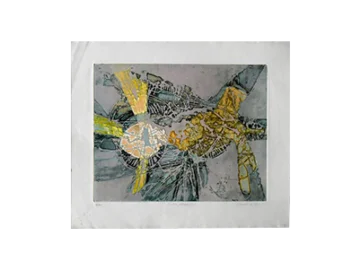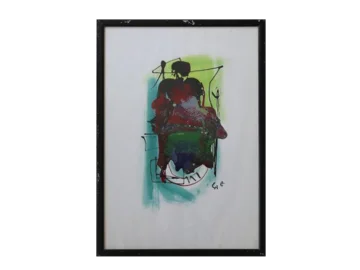


Colour lithograph, Soleil et Étincelles, Joan Miró, 1960s

Description
Colour lithograph, Soleil et Étincelles, Joan Miró, 1960s
Joan Miró, Soleil et Étincelles, 1960s
Colour lithograph
Signed in print
Artwork dimensions 58/74
Framed artwork
This lithograph appeared in the publication Derriére le Miroir 164/165. L’Oiseau Solaire, L’Oiseau Lunaire, Etincelles, published by Maeght Gallery in 1967. A lithograph by Joan Miró, the Catalan painter, sculptor and ceramicist. The Surrealist master is one of the most important Spanish artists of the 20th century and one of the greatest figures in modern art.
A painting is made from brushstrokes, just as a poem is made from words.
– Joan Miró
Miró’s works are interpreted as belonging to Surrealism, as an expression of a return to childhood, and as sandboxes for the subconscious. Miró’s style is characterised by vivid colours combined with simplified forms reminiscent of a young child’s drawings. Initially, Miró worked in various fashionable styles, such as Fauvist and Cubist. In 1920, he travelled to Paris several times, and the following year he settled there permanently. He met Pablo Picasso, Wassily Kandinsky and many other eminent artists. In 1924, he joined the Surrealists around André Breton, but although he worked under their influence, he remained on the fringes of the movement, retaining his position as an outsider.
Influenced by Surrealist poets and writers, he began to develop his own style: a map of weightlessly suspended coloured signs and poetic forms that evoke both the seemingly naïve freshness of invention and the exuberant, Baroque Catalan spirit. The elements of his adopted aesthetic included organic forms and flattened drawing with sharp lines. Through symbols, finger marks, handprints, water on paper and an apparently delicate line on fabric, the master transformed the world around him with striking simplicity. He created a reality filled with poetic and dreamlike transformations.
His lifestyle reflected a profound need for cleanliness, order and discipline. The studio was kept tidy, and the works were arranged according to a system known only to the artist. He grew up in Barcelona, spent part of his life in Paris and, although in 1956 the artist decided to move to Palma de Mallorca and Villa Son Abrines, his life continued to follow a Barcelona–Paris rhythm. The choice of Palma de Mallorca was not accidental either, as his wife, Pilar Juncosa, was born on this Mediterranean island.
The starting point for Miró’s paintings is often a dominant patch of colour, from which the world emerges through the rigorous organisation of its irrational form. However spontaneous this creation may appear, only the initial stage came about freely; the rest is meticulously controlled in accordance with Miró’s requirements for balance in the composition. By freeing his paintings from illusion and anecdote, Miró reached the limits of simplification. He is credited with the painting technique grattage, which consists of scraping paint from the canvas.
Artwork in original vintage condition. The frame shows light signs of use.
Product information
| Condition | Original - Good [The item shows signs of normal use and material ageing] |
|---|---|
| Designer | Joan Miró |
| Country of origin | France |
| Years of production | 1960-1969 |
| Style | Surrealism |
| Materials | Paper, Other |
| Colour | Multicoloured, Clear |
Dimensions
| Width | 74 cm |
|---|---|
| Depth | 3 cm |
| Height | 58 cm |
We ship worldwide. International shipping cost is calculated at checkout.
Delivery cost within Poland: 10,55 €
Estimated delivery time: Up to one week
Loading form…